Hold This a Minute: The Small Ritual of the Café Loo Key
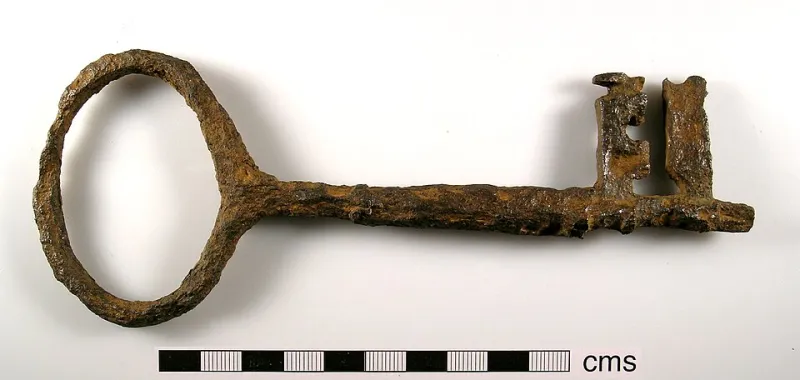
Photo: Sussex Archaeological Society, Liz Wilson, 2005-03-16 13:20:02, CC BY-SA 4.0, via Wikimedia Commons
You ask where the loo is and the person behind the counter doesn't point. They reach for something. A spoon. A cork. A lump of wood with a key screwed to it. The handover lasts two seconds and tells you more about the room than the menu board does.
The fob is the first honest thing a café gives you
Menus are marketing. The fob is admin. Nobody designs a loo key to flatter you. It is a solution to a practical problem — that cafés lose keys and customers wander — and the solution people settle on says plenty about how they run the place and how they think about the people who come in.
Spend a month asking and you end up with a rough taxonomy.
- The wooden spoon. Kitchen surplus, hole drilled through the handle, key on a split ring. Somebody did that in an afternoon with a drill and a cup of tea. It may well be the most common fob in Britain, and it is the most cheering.
- The cork on a shoelace. Slightly better than a spoon, because it floats — a consideration you only appreciate if your loo is at the back of a shop that also sells plants.
- The plywood tag. Frequently the size of a slice of toast, sometimes with the café's name burned into it. Every one is a small confession: we have lost keys before, and we are not going to lose this one.
- The brass key on a gym wristband. Suggests a landlord, a lease and a certain amount of negotiation.
- The code. Four digits on a scrap of till roll in biro that is nearly out. A different kind of trust: you are being given the door without the object.
- Nothing at all. 'It's open, just go.' Highest trust on the scale, and usually the mark of a café that has been on that street long enough to know everyone's dog.
What the key actually tells you
Not much about hygiene, as it happens. A spoon fob is not a hygiene certificate. A grubby bit of string says the key has been through a lot of hands and could do with a wash; a laminated card on a fresh ball chain says someone in that café thinks about surfaces, which usually means they think about the sink as well.
The real information is in the details around the door. Is there a hook on the back of it, at a height a person can actually reach? Is the soap a pump, a sliver, or a dispenser that has been empty since the Tuesday before last? Is there a bin, or a shelf where a bin used to be? Small things — but they are the difference between a café that thinks about you for the thirty seconds you are not buying anything and one that doesn't.
And then there is baby change. Every parent reading this knows the drill: the café that has one, and the café that says 'we've got a big sink' with a look on its face. The loo key is the only part of the café a customer gets to hold in their hand. It should feel like the place wants you to have it.
The size question
Big tags are practical, not suspicious. A café with a key the size of a beer mat has made a decision about its own back office: we are chaotic, and we are working with it. Small brass keys on fine chains tend to belong to a different sort of place, generally one with a hand dryer that works and a spare loo roll on the shelf. Neither tells you whether the coffee is any good. Both tell you something about how the day gets run.
The handover, and the hand-back
The first half of the ritual is the giving. The second half is the returning, and it is the one people get wrong.
Dropping it on the counter as you leave is fine and normal. Handing it back to a human is better — not because of etiquette, since nobody is keeping score, but because it is a small exchange with a person who has, for a minute, been responsible for you. It is a cousin of the nod before the order and the thank-you at the door. In a café where the same three people work every weekday, the hand-back is often the only conversation you will have all morning, and it is a good one.
You can also read the counter by where the keys live. A chipped mug by the till. A hook labelled with marker. A drawer. A bowl that also holds a dog lead, two pens and an elastic band. That bowl is the café's junk drawer, and being allowed to dip into it is a small privilege.
What it means for the street
There is a version of this where the loo key is a bouncer: you ask, you are looked up and down, and a key arrives on a chain attached to a wooden oar. That café exists, and it is rarely the one you go back to. The ones you go back to hand it over without ceremony, point vaguely in the right direction and say the thing that isn't about the key at all: 'Mind the step.'
A neighbourhood café survives on the fact that people feel at ease in it, and the loo key is a tiny, repeated test of that ease — thirty times a day, all year, for years. Get it right and nobody notices. Get it wrong and the room goes slightly cold in a way that's hard to put your finger on.
So next time you are standing at a counter waiting for a lump of wood, have a look at it. Not to grade the café. Just to read the room. The spoon is a small, daft, deeply British answer to a practical problem, and it is one of the nicest things about the high street.