The Tub Behind the Counter: A November Inventory of the Street's Lost Umbrellas
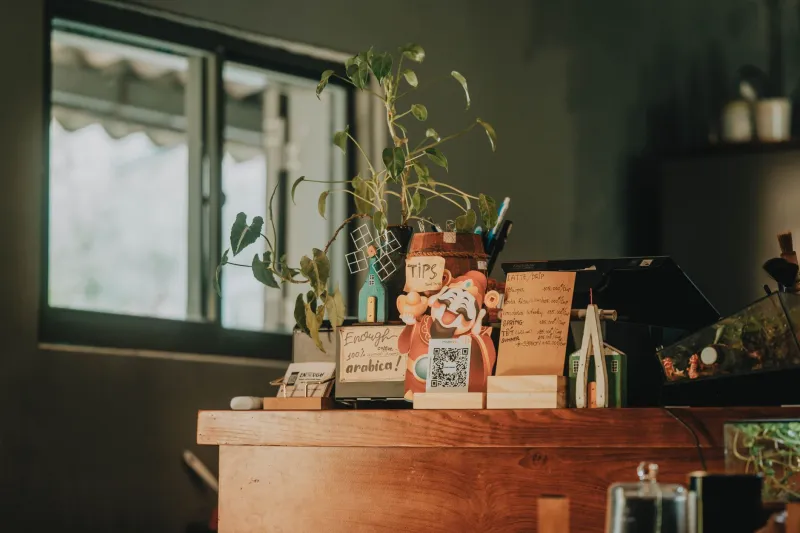
By the second week of November 2026, the tub behind the counter has stopped being a tub. It is now a small civic institution. It sits between the biscuit tin and the stack of takeaway lids, and it holds the things the street has put down and not quite picked up again: three umbrellas, a single leather glove, two pairs of reading glasses, a plastic dinosaur, a child's cardigan, and a paperback with a bus ticket marking page forty-two.
We tend to call this the lost property box, though it is rarely a box and the property is rarely lost in any dramatic sense. It is more of a holding pen for the temporarily misplaced. A cafe does not advertise it. It does not need to. By November, the ritual is understood: you ask, the person behind the counter lifts the lid, and the two of you peer in like archaeologists at a very small, very damp dig.
The Box by the Biscuits
The position matters. In most neighbourhood cafes, the lost property tub lives low and slightly out of sight, near the fridge or under the till, because it is not a display. It is a courtesy. It says: we know you will come back. It also says: we are not a cloakroom, but we are not going to throw your umbrella in the bin either.
That small act of keeping is a kind of trust. A chain coffee shop might have a formal policy and a laminated label. A neighbourhood cafe has a tub, a vague memory and a staff member who will say, with real conviction, that they think a blue umbrella came in on Tuesday but it might have been the week before. The system is imperfect. The sentiment is not.
A Census of Umbrellas
Umbrellas are the great repeat offenders. They arrive in a burst of drizzle, get leaned against a chair, and then vanish from memory the moment the flat white lands. By mid-November, the tub has a small forest of them: a compact black one with a broken spoke, a long navy one that looks like it belongs to someone's dad, and a transparent dome that has clearly been to a festival and never fully recovered.
You can read the street in them. The compact ones suggest commuters, people who walk to the bus stop and then fold themselves into a seat. The long ones suggest school runs and market trips, the sort of errand that requires a proper umbrella rather than a hopeful one. The transparent dome is harder to place, but it has the air of a Tuesday afternoon that got out of hand.
What is striking is how few are ever reclaimed. People do come back, of course, but often they return with a different umbrella, or they buy one from the shop next door, or they simply accept the weather and get wet. The tub fills anyway. It is a reminder that a cafe is not just a place where things are bought. It is a place where things are left, and the leaving is part of the relationship.
Gloves, Glasses and the Small Evidence of Routine
The single glove is a classic. It sits at the bottom of the tub with the quiet dignity of an object that knows it will never be paired again. Somewhere on the street there is a person with one warm hand and one cold hand, and they have probably already given up. The reading glasses are more poignant. They suggest someone who came in for a quiet hour with the paper, took them off to read the small print, and then walked out into a day that did not require close attention.
Then there are the children's things: a dinosaur, a cardigan, a hair bobble shaped like a strawberry. These tell you that the cafe is part of a school run, a playdate, a Saturday morning that ran longer than expected. They also tell you that the staff have a higher tolerance for small plastic animals than most workplaces. The dinosaur has been there since October. It has been named. This is not a formal policy, but it is a sign of a cafe that knows its regulars.
The Trust Economy of Keeping Things
A lost property box is a small exercise in community accounting. The cafe keeps the thing. The owner may or may not return. Nobody invoices anybody. There is no storage fee, no claim form, no proof of purchase. The whole arrangement runs on a shared assumption that most people are basically decent and that a neighbourhood is a place where you can leave a glove behind without it being treated as abandoned.
That assumption is not naive. It is practical. A cafe that throws out every forgotten umbrella saves itself a bit of clutter but loses a small piece of goodwill. A cafe that keeps them, even badly, even in a tub with a crack in the lid, is saying that the street is still a place where things can be held for a while. In a city, that is not nothing. In a neighbourhood, it is the whole point.
How to Reclaim Your Umbrella Without Becoming a Legend
There are a few gentle rules. First, ask before you describe. The staff have heard every umbrella story and they will not be impressed by a detailed account of the handle. Second, be honest about the odds. If you are not sure it is yours, it probably is not. Third, do not claim the transparent dome unless you are prepared to explain the festival. Fourth, if you do reclaim your umbrella, consider leaving the one you borrowed from the office in its place. The tub has a way of balancing itself out.
And if you are the owner of the plastic dinosaur, please come forward. It has been given a name and a small paper hat, and the staff are starting to get attached.
What the Tub Says About the Street
By midwinter, the lost property box is a quiet barometer of footfall. It fills after wet weekends and empties after a clear spell, when people remember what they have left behind. It tells you which days are busy, which regulars are forgetful, and which small children are allowed to choose their own accessories. It is not data in any formal sense. It is better than that. It is evidence of routine, of people coming and going, of a street that uses its cafe as a place to pause.
The next time you are in, glance towards the counter and see if you can spot the tub. You may not need it. But it is there, keeping the street's forgotten things until the street remembers them. That is a modest kind of service. It is also, in its way, the whole neighbourhood in miniature.